MYRRH
Herbs in Egypt-Myrrh
By
Susan Quan
WARNING: Do Not attempt to use or administer any herb or formula without first consulting a qualified licensed medical doctor. Use of such herbs and formulas is not implied or intended in any of my articles.
Introduction
"Oh, great Pharaoh Hatshepsut, it is my wish that you as the living god, plant the fragrant myrrh trees to surround my temple." spoke the god Amun to the Queen's priest.
Subsequently, the obedient Queen dispatched five ships to Equatorial Africa to the Land of Punt. Myrrh was reported as indigenous to this region.
Envoys of the Queen arrived in Punt and traded their products for the following: an ax, a knife, jewelry, gold, ebony, ivory, cinnamon, dogs, cattle, apes, panthers, slaves, sacks of myrrh and 31 sapling myrrh trees.
The successful expedition returned home with this cargo for Hatshepsut. She was very pleased and immediately made a formal offering of myrrh to the god Amun.
Next, Hatshepsut began to carry out her promise to Amun to create "a Punt in his house, . . . according as he commanded". Hatshepsut duplicated the hilly landscape of Punt by developing miniature terraces that surrounded Amun's temple. The myrrh was planted on these terraces. According to the legend found on the walls of Hatshepsut's temple to her tomb, Amun appeared and strolled pleased and satisfied through the beautiful garden that Hatshepsut created for him. In fact, he was so gratified that he offered the Queen "life, stability and satisfaction . . . forever."
Imhotep of the XVIIIth Dynasty vizier to King Zoser, who is Amenhotep (son of Hapu), was the legendary Egyptian healer. Not only was he a healer, he was a scribe and architect and considered the "Father of Medicine" in Egypt.
Achaeologists have uncovered many bronze statues of Imhotep the physician god who in concert with the Godess Isis, Mother of Herbs, bestowed their curing gifts on the people of Egypt.
According to the Ebers Papyrus, myrrh has been used since 2000 BC, humans have used herbs, minerals, and animals as food and medicine. In modern times, some of these are still used in different forms.
In Egypt, myrrh was held in high regard and had many uses. The information that follows indicates just some of the ways that this herb was used.
Herbal Information
MYRRH
Common Name: MYRRH (Arabic for "bitter")
Botanical Name: Commiphora molmol and other species.
Chinese Name: Mo Yao
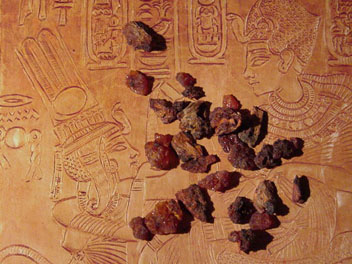
Myrrh is a resinous gum obtained from bushes primarily indigenous to the Middle East, Far East, and Africa. The appearance of myrrh in the marketplace today as hundreds of years ago may be in the form of small, semi-transparent, hard, golden nuggets or a powder ground from the nuggets. There are different species and grades of quality.
Uses of MYRRH:
1-Incense - Powder or small granules are placed upon a piece of burning charcoal. This produces an aromatic and copious smoke. Very little is needed to achieve this result. In ancient times, this resin was highly prized.
Myrrh was used for religious rites along with frankincense in the temples and most likely the homes of those citizens who could afford it. It was also an expensive gift of tribute to royalty, nobility, and high officials.
Considering that most of the myrrh was imported, it was probably quite expensive and sold in various grades priced according to quality.
2-Medicine-It is believed that MYRRH was used medicinally by combining it with vinegar, wine, or beer that the patient would then drink. Using it with these drinks would have been efficacious in breaking down the resin for the system to absorb and digest. Mixed this way with other botanicals it could be used as an abortifacient.
Myrrh is not easily soluble in water, however, the acidic and alcohol content of vinegar and wine may have improved absorption.
Myrrh could also be used as a poultice for sores and wounds. It acted as a bacteriostatic (to repel bacterium), an antiseptic (to destroy bacterium) to keep the wound clean, and an astringent (to draw soft tissues together contracting vessels to stop bleeding). This herb may have been especially desired during a skirmish or all out wars and was surely part of the pharmacopoeia of the physician.
How much was used and how it was prepared depended upon the purpose.
3-Religious Purposes-Myrrh was offered as incense in the temples and special rites and ceremonies.
Although, this herb was expensive, those that could afford it used it in their homes as incense and medical purposes.
Also, remember the bit about the three kings going to Bethlehem to visit the Christ child. One of those kings, I am sure you will remember, brought frankincense and myrrh. These herbs were considered on the same level as gold and a welcomed and prized gift honoring the giver.
Properties of the herb: astringent, antiseptic, bacteriostatic, and stimulating.
MYRRH was used primarily but not exclusively for the following:
Broken bones, sprains, bruised or torn ligaments, pain, as an anti-bacterial and astringent wash for sores and abscesses, rheumatism, digestive, absence of menstrual cycle, pain during menstruation, and for normalizing mucous membrane action.
This herb was used internally and externally for several of the above-mentioned ailments.
Contraindications (Possible adverse effects): Again, do not use without the advice of a qualified, licensed physician. Overuse or misuse of this herb may cause negative effects, not exclusive to, but especially in the urinary tract. Constant use or abuse of myrrh may adversely effect the bladder and kidneys.
WARNING: Do not use myrrh during pregnancy or if you think you may possibly be pregnant.
Ancient Formula
Note: The following formula is strictly for educational and informative purposes please do not use them without the advice of a qualified, licensed medical doctor.
3 grams of myrrh pulverized into a powder
1 ounce of alcohol
1/4 cup of almond oil or any massage oil
Grind the myrrh with a little alcohol to form a paste. Mix the paste with the rest of the alcohol in a small glass jar with a screw top allowing the myrrh to form a tincture. Periodically shake the jar vigorously (a least once a day). When it appears that most of the grains of myrrh have dissolved, strain the liquid through a clean linen handkerchief. Mix the strained, clear liquid with oil, shake well and leave the jar open so that the air will evaporate the rest of the alcohol. Shake to blend periodically. For External Use Only.
This formula has a history of being used in the following ways:
In the Bath for fragrance and soft skin
As a massage oil for tired or sore muscles
Aromatherapy
As an anti-fungal
Mix with distilled water as a mouthwash for gum and other mouth sores; the water is then expelled from the mouth into a basin.
Constituents of Myrrh:
Volatile oils such as, limonene, eugenol, pinene, resins, gum, ash, salts, benzoates, sulphates, malates, and acetates of potash.
Article copyright by Susan Quan 2001. All rights reserved.
References:
1-"A Barefoot Doctor's Manual", The American translation of the official Chinese paramedical manual. (p.755), Running Press, Philadelphia Pennsylvania.
2-"A Modern Herbal" by Mrs. M. Grieve F.R.H.S. edited and introduced by Mrs. C.F. Leyel. (p.p.571-573), Dorset Press, New York, New York.
3-"Chinese Herbal Patent Formulas: A practical Guide" by Jake Fratkin, O.M.D. (p.119), Shya Publications, Boulder, Colorado.
4-"Magic and Medicine of Plants" from Reader's Digest (p.p. 13-14 and p.p.51-52), Reader's Digest Association, inc., Pleasantville, New York.
5-American Herbalism: Essays on Herbs & Hebalism by Members of the American Herbalist Guild, edited by Dr. Michael Terra, O.M.D., (p.p. 3-29), The Crossing Press, Freedom, California.
6-Photographic images are by the author, Susan Quan, Copyright 2001, the background image in the photo is from a book called Treasures of Tutankhamu, Copyright 1976 Metropolitan Museum of Art. Use by permission. 7-web1.ea.pvt.k12.pa.us; arabworld.com; renoldsoffice.com. Clip art courtesy of Nerferchichi at nerferchichi.com. and Hathor's Realm geocities.com/SoHo/Atrium/4908/index.html
|
 |


 Kemet Home Page |
Herbs and Medicines of Egypt |
Temple of Amun |
Shrine of Mut |
Images from Opet |
Offerings |
Art Gallery |
Coming Soon |
Contact |
Related Links and Sites
Kemet Home Page |
Herbs and Medicines of Egypt |
Temple of Amun |
Shrine of Mut |
Images from Opet |
Offerings |
Art Gallery |
Coming Soon |
Contact |
Related Links and Sites