|
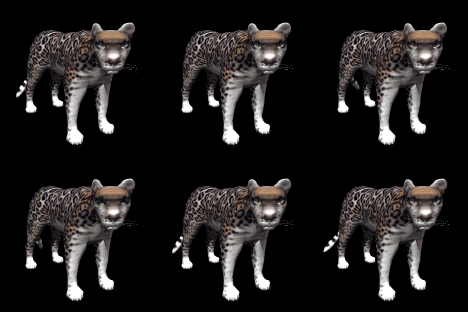
Below right is Mut's favorite cat and guardian named Nefer Merytamun (Beautiful Beloved of Amun).
Be careful, he is watching. May we suggest no sudden movements, epecially towards the Goddess.
Mut, the vulture goddess is part of the Theban triad of Amun and Amun's adopted son, Khonsu (the moon god), her son.
She wears the the vulture headress with a white crown atop it and is vitually indistinguishable from Isis. Clearly she is identified only by her named being scribed next to her image.
Mut is one of the "Eyes of Ra" along with her sisters, Tefnut, Sekhmet and Bast.
As the personification of Upper Egypt, she is portrayed suckling the king as the "Divine Mother of Per'a-a (Pharaoh)".
Her other forms include being portrayed with the head of a woman, a man, a vulture, a lioness, or the body of a woman with the head of a man. According to some scholars, this proves that Mut had both the reproductive attributes of a man and a woman.
This theory is apparently validated by Mut being shown holding a phallus and being addressed as "Sekhet-Bast-Ra" when in the form of a man's head on a woman's body.
The festival, Opet (Ipet), is celebrated during the months of the Nile inundation.
During this festival the shrine of Amun would lead the procession from Luxor in the North to Karnak in the South on a sailing barge (a flat boat which could carry a substantial amount of weight, carrying a barque or bark. Look for an image of a barque on the Opet Images page).
The barges would have temples and shrines decorated in precious gold, silver, Lapis lazuli (a bright, opaque, cobalt blue, the finest of which has gold inclusions running through it), turquoise, malachite (an opaque emerald green stone with darker green color running through it in a somewhat concentric pattern), and azurite (another blue stone) the last two are nearly always a product of copper mining. These including other costly offerings gave the vessel an appearance worthy of the gods.
The peak of the festival occurs during the first two months as the waters rise to their fullest height.
Women dressed in vulture headresses occupied the Mut's vessel, while those fo the Khonsu vessel wore the hawk headress.
The festival goers continued on to the West Bank to visit the tombs of their ancestors.
Purpose of the Festival
The apparent purpose of this festival during the inundation is symbolic of fertility.
Because the statues of Amun and Mut are housed separately, they are brought together during this time of year to be "joined". Mut is "fertilized" and then taken to a special "birthing house" to "give birth" to Khonsu (god of the moon).
Mut is also know as "she who gives birth, but was not born of anyone", in other words self-created.
Reference Sources:
touregypt.net/mutform.htm;
pages.ancientsites.com/~Tjeti_Sobkneferu/Amun/opet.html;
ancienthistory.miningco.com/homework/ancienthistory/library/bl/bl_opet.htm;
sis.gov.eg/egyptinf/tourism/html/luxor1.htm;
civilization.ca/membrs/civiliz/egypt/egcrgm3e/html;
fellowshipofisis.com/liturgy/panthea9.html
|
|


 Kemet Home Page |
Herbs and Medicines of Egypt |
Temple of Amun |
Shrine of Mut |
Images from Opet |
Offerings |
Art Gallery |
Coming Soon |
Contact |
Related Links and Sites
Kemet Home Page |
Herbs and Medicines of Egypt |
Temple of Amun |
Shrine of Mut |
Images from Opet |
Offerings |
Art Gallery |
Coming Soon |
Contact |
Related Links and Sites